Renaissance of the Library, NSA 2011 – No Poster, but a Presentation!

Sometimes thinks take other ways than expected. In spring I applied for the Nordic Sociological Association (NSA) Conference in Oslo. And my paper concerning the “Renaissance of the Library” was accepted for the poster presentation – I thought. But some weeks ago Prof. Ragnvald Kalleberg contacted me: I should be one of the presenters in his session “Sociology of Science” (this Friday afternoon). I was quite surprised!

Now my preparation for this presentation is finished. I was pleased to write a paper concerning my presentation topic that you can find here.

Another task during the session will be, that I will commentate Ragnvald Kallebergs presentation “Academics communicating with citizens in publics”. I am looking forward to do so, because this is a really interesting topic that is connected with my work in a theoretical and a practical way (some of you may think about “Space-Expedition: Konstanz”).

Creative Commons License

„Die Weisheit baut sich ein Haus“

Ausstellung zur Architektur und Geschichte von Bibliotheken, Pinakothek der Moderne in München

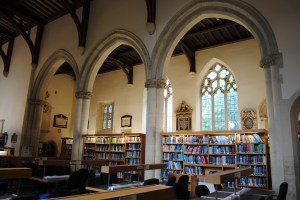
Vom 14.7.-16.10.2011 wird die Bibliotheksarchitektur das zentrale Thema in der Pinakothek der Moderne sein. Schon der Titel ist verheißungsvoll! So spricht er doch in der Gegenwart, die Weisheit „baut“ und nicht „baute“ sich ein Haus – ein Prozess also, der weiterhin andauert und der es wert ist, in seiner Prozesshaftigkeit (der historischen Entwicklung) dokumentiert und präsentiert zu werden. Im vom mir häufig angesprochenen widersprüchlichen Diskurs vom Aussterben und der Renaissance der BibliothekenBibliothek des St. Edmund Hall Colleges scheint die Ausstellung die Position der Renaissance zu stärken. Zeitgenössische Bibliotheken werden jetzt und auch in Zukunft gebaut. Bibliotheksarchitektur ist ein klassisches und zugleich modernes Thema. So liegt der Schwerpunkt der Ausstellung vor allem auf der modernen Bibliotheksarchitektur. Ich bin sehr gespannt auf diese Ausstellung!

Hier gehts zur Ausstellung und zu weiteren Informationen des Architekturmuseums der TU München.

Creative Commons License

Nordic Sociological Association Conference

(English version below)

Det er fantastiskt! Jeg kan delta i konferansen fra Nordic Sociological Association i Oslo og presentere mit poster. Postern har titteln ”Renaissance of the Library: Catalyser for Participation in Cultural Life and Centre of Urbanity”.

Konferansen begynner etter Summer School in Comparative Social Science Studies, derfor kan jeg være to uker i Oslo. Jeg gleder meg veldig til o være i Norge.

Mer informasjon om konferansen kan du finne her.

———

April was an amazing month! First I thought it would be a quiet, peaceful month. But then it was a lot of work! I’ve got an acceptation for the Nordic sociological Association Conference 2011 in Oslo. So I will present my poster “Renaissance of the Library: Catalyser for Participation in Cultural Life and Centre of Urbanity” in August in Oslo! Weiterlesen Nordic Sociological Association Conference

Readers Declaration vs. Mr. Bean

Sometimes library research can be both, hard work and lots of fun! While I was thinking about Lincoln College Library in Oxford, its sacred building (the former town church of Oxford) and the fact that we have to be quiet in a library, I found Mr. Beans „The Library“. So I would like to give you all the chance to compare the behaviour that is requested in the „Readers Declaration“ of the Bodleian Library in Oxford and Mr. Beans perfect performance!

„I hereby undertake not to remove from the Library, nor to mark, deface, or injure in any way, any volume, document or other object belonging to it or in its custody; not to bring into the Library, or kindle therein, any fire or flame, and not to smoke in the Library; and I promise to obey all rules of the Library.“ (Readers Declaration of the Bodleian Library Oxford)

And here you can see the best imaginable reader:

Information Architecture in Libraries – Participation in “Techno-Topologies”

Last weekend I took part in the Conference „Techno-Topologies“ in Darmstadt (Germany) and presented results of my PhD project Spaces of Knowledge”.

It was a great organised conference with a friendly atmosphere supporting the young researcher’s projects. My presentation was part of the section “Orientation and Navigation” and therefore I focused on the “Technically induced Orientation and Navigation from a Perspective of Spatial Sociology”. There have been lots of interesting and forward-looking questions and comments.

I planned to take a voice record of my presentation but unfortunately I forgot to start the recorder at the beginning. So I can just provide the slides without the corresponding sound.

Creative Commons License

Tagungsvorbereitung für die „Technotopologien“ mit Tagxedo

Ich mag Tagungen. Und Vorträge auch. Trotzdem gibt es so Tage, da fällt mir die Vortragsvorbereitung unendlich schwer. Doch Dank eines genialen Tipps meiner Kollegin Anna Lipphardt ist meine Tagungsvorbereitung für die „Technotopologien“ das reinste Vergnügen! Anna hat mich auf Tagxedo aufmerksam gemacht. Tagxedo macht aus jeder Art von Text kreative, sehenswerte und wunderschöne tagging clouds. Kurzerhand habe ich meinen vorbereiteten Vortrag (deutsch) in einen „tagging star“ verwandelt.

Eigentlich ist es logisch, aber überrascht hat es mich trotzdem, dass die Tags die thematischen Schwerpunkte des Vortrags so deutlich darstellen: Die Bibliothek steht im Zentrum, hier werden der Raum, die Architektur und Orientierung und Navigation untersucht. Informationen und Informationsarchitektur haben ebenso wie Wissen und Universitäten materielle und soziale Funktionen. Amazing!

Das Paper zum Vortrag findet man übrigens hier.

Creative Commons License

„Techno-Topologies“-Conference

I am very happy to be invited to the Conference „Techno-Topologies“ in Darmstadt (Germany), in March 2011. I’ll present selected results of my phd project „Spaces of Knowledge – Operationalisation of Knowledge in University Libraries”.

The project focuses on the interaction of space/architecture and social practice in university libraries. Libraries are made for storage, development and transformation of knowledge. They are on the one hand existing architectural spaces; on the other hand are the genesis and the transfer of knowledge embedded in social processes of learning and teaching. The central question is: In which way is knowledge operationalised in libraries, by social practice and architecture? To answer this, a comparative case study has been designed and selected university libraries have been analysed. The libraries of Konstanz and Oxford are in the major focus of the case study.
In my presentation I’ll show that information architecture, a concept better known in the field of web design, is an important function in libraries. The results of the project illustrate the spatial challenge of library users and connect this with the technical support for orientation and navigation within the library spaces. Navigation and orientation will be traced both on the macroscopic and the microscopic level. The macroscopic level relates to the whole building, the microscopic level relates to each single shelve and book.
Library architecture can work as a medium of orientation. But it can also be like a labyrinth and hinder users in their orientation and navigation. It, too, works as an access denier: If one hasn’t the cultural capital (Bourdieu) and therefore the experience how to use a library, he/she will get lost within the rooms, shelves and books. The collected data material (interviews, participant observations, mental maps and photo documentation) illustrates that materiality and technology not only make a contribution to the perception and experience of space, but also have effects on the processes of knowledge production. Material and social closing mechanisms can configurate progresses of (corporate) identity and affect the behaviour towards libraries and their contents.

More information concerning the conference is provided here.

Creative Commons License

Heilige Hallen der Welt der Wissenschaften

Nach zwei Monaten Forschungsaufenthalt bin ich aus Oxford zurück. Bepackt mit Datenmaterial aus teilnehmenden Beobachtungen, ExpertInneninterviews, Interviews mit BibliotheksnutzerInnen, Fotodokumentationen …

Wunderschöne, eindrucksvolle, spannende und architektonisch atemberaubende Bibliotheken durfte ich besuchen und zum Arbeiten nutzen. Jetzt geht es an die Auswertung des Materials. Was sicherlich bei Anblicken wie diesem Foto vom Keble College eine sehr schöne Arbeit ist.

Und dann erhalte ich zufällig den Link zu einer Fotostrecke der „Most Beautiful College Libraries“! Und schon wieder packt mich das Reisefieber beim Anblick dieser Heiligen Hallen der Wissenschaft!